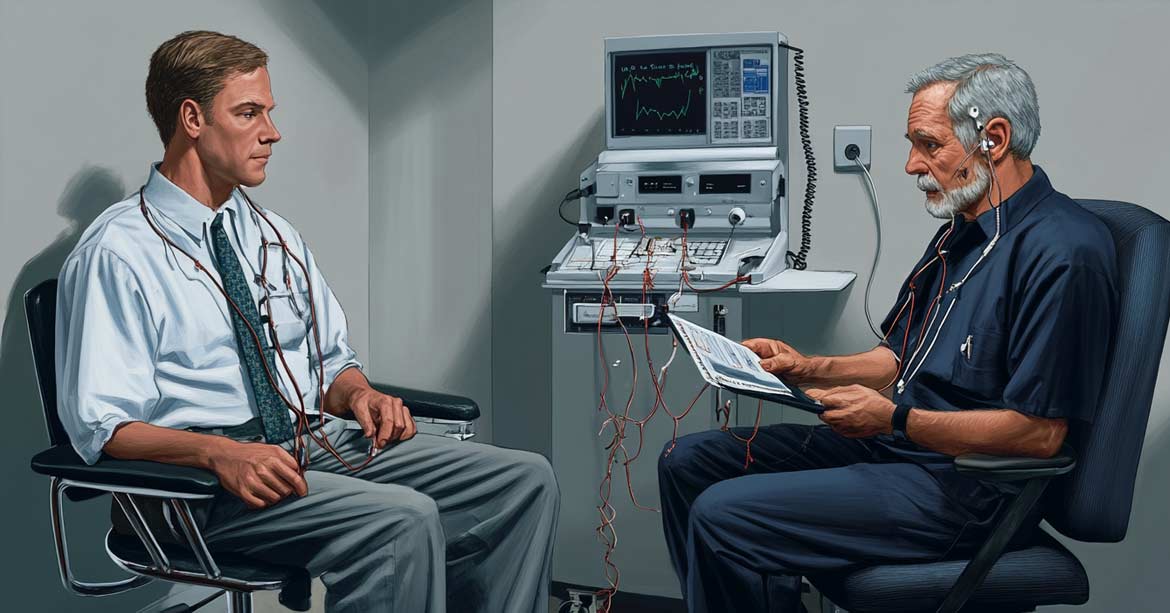
A polygraph test is carried out in three phases: a pre-test interview, the test itself and the analysis of the charts. During the test, sensors placed on the body record three signals of the autonomic nervous system at once —breathing, cardiovascular activity and the galvanic skin response (sweating)— while the person answers a questionnaire agreed beforehand. There are no surprise questions: the examiner reviews every question one by one during the interview. Each set of questions is repeated at least three times to check that the reactions are consistent and not an isolated spike caused by nerves. Validated techniques reach an accuracy of around 85-90% according to the American Polygraph Association, and the National Academies review (2003) confirms they are right well above chance. The test itself lasts between 60 and 120 minutes, and the full appointment between 2 and 3 hours.
What happens in the pre-test interview?
The interview is the most important part. The examiner explains how the equipment works, reviews the person's medical and emotional state, and goes through each question so there are no surprises. This is also where the wording of the relevant questions and the comparison questions is agreed —clear, closed questions the person can answer with a straight yes or no. Acclimatising the examinee lowers the baseline nervousness and produces a cleaner reading.
How is the test itself conducted?
The examiner fits the sensors —pneumograph bands on the chest and abdomen, a blood-pressure cuff and electrodes on the fingers— and runs several series of questions, repeating each series at least three times. Consistency across repetitions is far more informative than a single reaction. The person only has to do one thing: breathe normally and answer clearly.
How are the results interpreted?
The polygraph does not decide anything by itself. The examiner scores the charts by comparing the reactions to the relevant questions with those to the comparison questions, and expresses the outcome in terms of probability, never as an absolute certainty. That is why the examiner's training weighs as much as the equipment.
Who carries out the test at El Polígrafo
At El Polígrafo the test is carried out by Fernando, a polygraph examiner and forensic psychologist, with a Stoelting CPS Pro system and techniques recognised by the American Polygraph Association. Everything is done with prior consent and full confidentiality.
In a recent private case, a person came in convinced they would "fail because of the nerves". After the pre-test interview and acclimatisation, the charts showed a clear, consistent pattern across the three repetitions, and the result was conclusive. It is a good illustration that the technique compares reactions rather than punishing normal nervousness.