El Polígrafo

The polygraph test

At the polygraph test we seek the truth and to achieve this it is necessary to follow a series of steps, each one more or equally important than the previous one.

  1. The interview

    Before a polygraph test is conducted, a good interview is crucial in order to delve deeper into the cause of the problem. Knowing the subject who is going to take the polygraph test, the various situations in order to be able to better establish the types of questions to be asked.

    The subject must sign a written voluntary consent form stating that he/she agrees to take a polygraph test, giving as much personal information as the polygraph technician requires, in terms of any illnesses he/she has had or has and whether he/she is taking any medication.

    The staff of the centre may ask the subject to administer various tests, such as psychological tests, drug tests (in case of suspicion of drug use), check possible "countermeasures" that the subject has planned to try to adulterate his physiological reactions, etc...

    The polygraph test
  2. Elaboration of the questions

    The number of questions to be asked, normally between no less than 3 and no more than 5, of each type of question: relevant, control or irrelevant, being of two types:

    Relevant questions

    The aim is to evaluate the subject's sincerity in their answer, control questions in which a highly suggestive reaction is expected from the subject, due to embarrassment, fear, etc., and it is expected that they will want to lie about it.

    Control questions

    Control questions are those in which the aim is to generate an intense emotional and physiological reaction in the subject in order to be able to compare it with the physiological reactions established in the relevant questions.

    Irrelevant questions

    These do not provoke any reaction in the subject to be tested. All questions are loaded into the polygraph software, setting up different series with different order of questions, sensors and electrodes are connected to the polygraph and to the computer.

  3. Test preparation

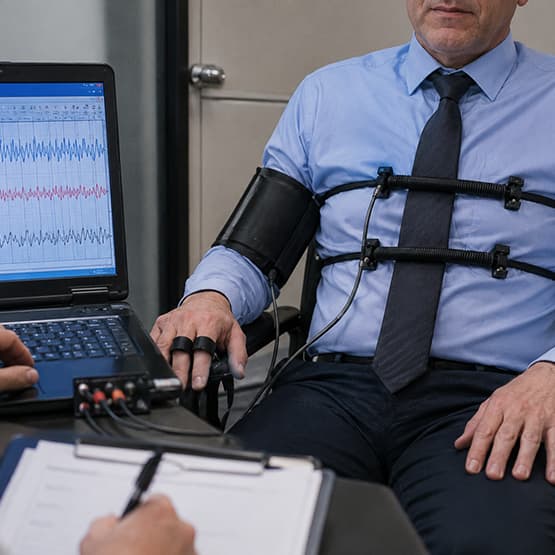
    The posture of the subject before the polygraph test It is important at the time of testing that you are barefoot, with your feet flush with the wall, wearing comfortable clothing and without accessories that may discomfort or oppress the recording of sensors and electrodes.

    He/she should be facing the wall, on a neutral plane, without stimulation, as pupillary dilation can sometimes be controlled, and his/her gestures and micro-expressions can be recorded.

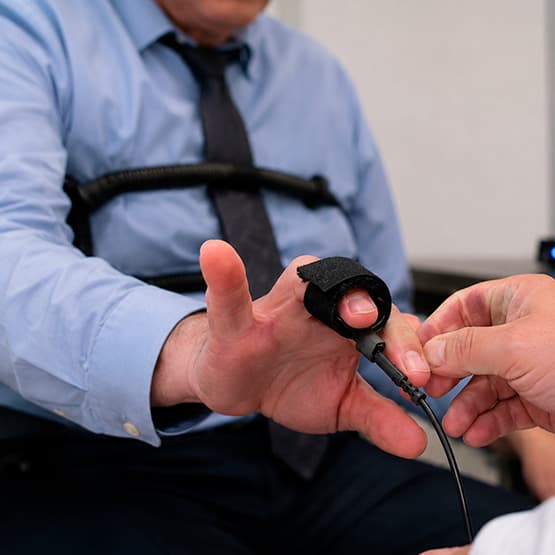
    Once seated, the subject is asked to sit on the recording pad, which assesses the subject's motor response. Once seated, the resistance-measuring electrodes are placed on intercalated fingers, together with electrodes placed on the same hand, which measure conductance, to obtain a complete record of the subject's motor response. galvanic skin sweating.

    Subsequently, the pleistesmographThe cuff is placed on the back of the thumb of the same hand to assess blood volume, in conjunction with the cuff placed above the crease of the arm, at 2-3 cm, with the manometer at a pressure of 60 mmHg, to see the individual's cardiac response.

    The polygraph test
  4. The Test

    Once the instrument has been calibrated, the technician proceeds to perform the polygraph test with the questions in a series of no less than 3, following the various established orders of agreed questions.

    Moments before starting the polygraph test, the subject is asked to take 2 seconds to answer each question asked by the technician, not to move, while possible gestures are observed, such as clearing the throat, sighing, breathing in, etc... and the technician must note them down in the polygraph software.

    Between each series, at least a 5-minute interval is left, where the subject is asked to clarify any anomalies or behaviour that may have occurred, such as changing an answer to a question from Yes to No, or from No to Yes.
    After the test is completed, the electrodes and sensors are removed in the reverse order in which they were placed.

    The polygraph test
  5. Final Outcome and Conclusions

    Once the polygraph test is completed, the subject is asked to leave the room, so that the technician can assess, with the help of the software's logarithm, the subject's probability of truthfulness or untruthfulness for each question.

    The polygraph technician will compare the physiological reactions obtained from the subject on the different control and relevant questions in order to determine whether the answers to the relevant questions are significantly higher or lower.

    After the polygraph test, it is necessary to carry out a thorough analysis, which must also take into account the gestures and actions that the subject may have made when answering the questions.

    If the results are clear, the technician meets again with the interested parties to communicate the results after payment of the service fee.

    The polygraph test
  6. The report

    The communication of results is a delicate moment, as there is a great deal of expectation to know the conclusions.

    The report can be oral, friendly and pedagogical, explaining in each question the likelihood of its truthfulness.

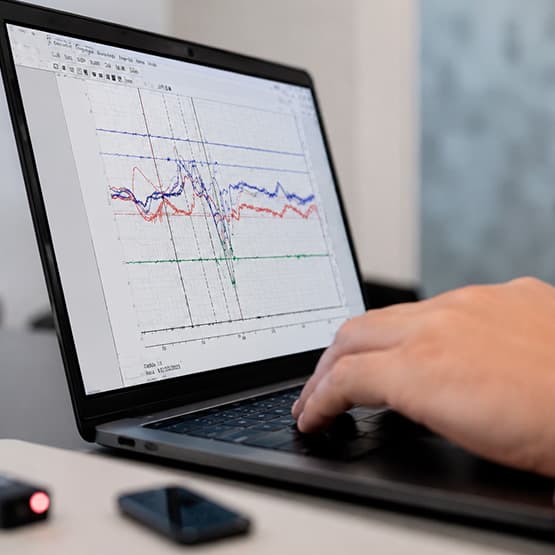
    The conclusions to each question should be illustrated and explained with graphs of the answers to each question.

    The polygraph test report is not a fundamental requirement, but it is important to have a written record of the entire polygraph testing process and to have a record for future reference.

    The polygraph test
  7. Other possibilities

    Sometimes an interpreter may be required, as knowledge of the language and its requirements is very important in order to understand the subject, the causes, etc... Therefore, the service will require this supplement.

    When the technician considers that it is necessary to carry out another type of test, such as psychological, personality or drug tests, there will also be an increase, depending on the test.

    In some situations, there are several people who have to take the test, for example for a job interview, or in a case of job or family mistrust... In these cases, depending on the volume, a supplement will be set for each person to take the test.

    In very exceptional situations, it may happen that the results are not entirely clear, so that it may be possible either to repeat the test, or to have to postpone the communication of results to the near future.

    If at any time during the test it is perceived that the test subject deliberately attempts to manipulate the test results, the test is automatically stopped and reflected in the report, as the test subject has previously signed the test voluntarily.

How reliable is the polygraph test?

The polygraph does not «read lies»: it records physiological responses — heart rate, blood pressure, breathing and skin conductance — to questions asked under a strict protocol. Leading international bodies such as the American Polygraph Association (APA) place the average accuracy of validated techniques between 87% and 90% when performed by a certified examiner; with full protocols and controlled conditions, that figure improves considerably.

The margin of error splits into two kinds of failure: false positives (truthful people whose anxiety triggers reactions that look like deception) and false negatives (people who lie and manage to contain their response). Every phase of our protocol is designed to reduce both: pre-test interview, control questions and numerical scoring of the charts.

That is why a professional report is never a categorical «guilty/innocent» verdict: it states a statistical probability of deception or truthfulness, backed by the charts and the scoring. To see exactly what the report includes, check our services and test conditions.

The pre-test: how we avoid false positives caused by anxiety

The human brain does not automatically distinguish between the stress of being unfairly accused and the stress of lying: both activate the sympathetic nervous system. That is the main source of false positives — and the reason the phase before the test matters as much as the test itself.

During the pre-test, the examiner builds trust, explains how the equipment works and goes through every question that will be asked later. Factors that could invalidate the measurement are also reviewed: medical history, medication, stimulants, lack of sleep or anxiety disorders. Nothing is asked by surprise.

This phase also has a filtering effect: it is common for someone who intended to distort the truth to volunteer relevant information once they see the rigour of the method. Many of the real polygraph stories we publish start exactly there.

Examination techniques: control questions and concealed knowledge

The industry standard is the Comparison Question Technique (CQT): it contrasts the subject's reaction to questions directly related to the matter under investigation with control questions that are uncomfortable but not accusatory. A person who is lying fears the relevant questions more; a truthful person reacts more to the controls. That differential pattern is what gets measured.

For certain cases we also use the Concealed Information Technique (GKT): instead of asking «did you do it?», it presents details that only the perpetrator and the investigators would know, mixed with plausible distractors. A marked reaction to the correct detail reveals concealed knowledge — one of the approaches most resistant to countermeasures.

The choice of technique depends on the purpose of the test, the nature of the facts and the profile of the examinee — never on the examiner's convenience. Our frequently asked questions cover the most common doubts about the procedure.

Factors that can distort the results

Interpreting a polygraph correctly means ruling out interference unrelated to the matter under investigation. Sleep deprivation, certain anxiolytics, untreated hypertension or a generalised state of alert can alter skin conductance and heart rate to the point of making the charts unreadable if not detected in time.

The environment matters just as much: the test takes place in a quiet room, without interruptions, at a controlled temperature and free of distracting stimuli. An uncomfortable or interrupted examinee generates baseline stress that contaminates the measurement and forces series to be repeated.

Knowing these limits keeps expectations realistic: the polygraph is not an automatic «truth machine», but a precision instrument that demands a controlled context and expert analysis. Be wary of anyone promising instant results anywhere, under any circumstances.

Analysing the charts: algorithm plus expert judgement

Once the question series is over, the real expert work begins: analysing the recording. The current standard combines numerical scoring — statistical algorithms that assign values to the variations of each parameter — with expert visual inspection of the charts.

Software can flag a probability of deception, but it is the examiner who reviews the artefacts: coughs, micro-movements, sighs or involuntary breathing changes that an algorithm would mistake for concealment reactions. Combining both analyses is what raises accuracy to international standards.

A serious report includes the charts and the detailed scoring, not just a conclusion. That transparency is the difference between a professional service and «a pollster with sensors».

The polygraph in the workplace: hiring and internal investigations

Beyond personal matters, the polygraph test has become a corporate tool: internal fraud investigations, misappropriation, information leaks or industrial espionage. In these cases the goal is not a criminal conviction, but clarifying responsibilities in order to decide with objective backing.

In personnel selection for high-trust positions — treasury, security, access to sensitive data — the test verifies the truthfulness of the CV, the absence of undeclared conflicts of interest and other factors a traditional interview can hardly uncover.

When an incident occurs without clear material evidence, the polygraph narrows the investigation quickly and, above all, clears the innocent: the greatest toll of an internal investigation falls on honest employees under generalised suspicion. If your company needs this service, tell us about the case — no obligation.

Legal validity in Spain and professional ethics

In Spain the polygraph test has no automatic evidentiary value in court: judges treat it as circumstantial or supporting material, not as decisive expert evidence. Its real usefulness lies in the private and extrajudicial sphere: mediations, negotiations and the resolution of personal or workplace conflicts, where a rigorous report is enormously persuasive.

The legitimacy of the test always requires express, free and informed consent. A professional examiner must refuse to perform it if coercion is detected, and the results are confidential: their use is strictly limited to the purpose for which they were requested.

That ethical framework is not an obstacle — it is the guarantee: a voluntary, documented and well-executed test defuses conflicts that would otherwise drag on for years.

Who performs the test?

All tests are performed by our examiner, who holds an official qualification with training accredited by the European Polygraph Academy and Fextor Polígrafos — you can see the certificates and diploma on our home page.

We work in Malaga with up-to-date equipment, a full protocol (pre-test interview, test and numerical chart analysis) and absolute confidentiality. Find out more about us or book your appointment — we will walk you through the process with no obligation.

Polygraph test in Malaga

Recover the health that uncertainty and doubts have robbed you of, because the truth will set you free. Call now and get information without obligation.