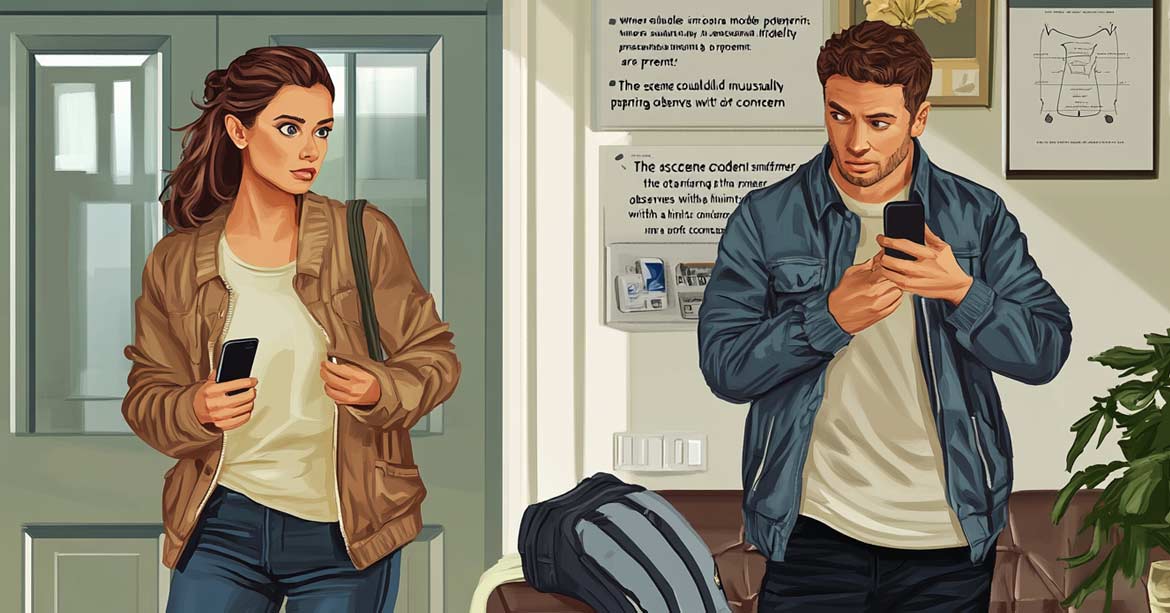
There is no single sign that proves infidelity on its own. Changes in behaviour —dressing differently, coming home later, suddenly guarding the phone or giving evasive answers— are only clues, not proof: they can be due to stress, work or a thousand reasons unrelated to cheating. Treating them as certainties usually does more harm than good. The sensible way to move from suspicion to certainty is to talk openly and, if the doubt persists and both partners agree, turn to an objective test. That is where the polygraph comes in: a voluntary test that measures physiological reactions to specific questions agreed in advance, with an accuracy of 85-90% according to the American Polygraph Association. It is not court evidence, nor a trick to "catch" anyone behind their back: it is a tool to resolve a couple's doubt with discretion and with the consent of both people.
Are there reliable signs of infidelity?
The honest answer is that no single sign is conclusive. These changes are often cited, but they are better read as hints that invite a conversation, not as verdicts:
- Changes in routine: starting to come home later for no clear reason, or going out often without including their partner.
- Changes in appearance: a sudden concern with looks or physique that was not there before.
- More secrecy with the phone: changing passwords or never letting go of the phone when it used to be no issue.
- Evasive answers: tense or inconsistent reactions to simple questions.
Any of these behaviours has innocent explanations. That is why the next step is not to spy —checking someone else's phone without permission can also breach their privacy— but to talk.
Is the polygraph useful for clearing up doubts?
Yes, when both people agree to do it. The polygraph does not read minds: it records breathing, cardiovascular activity and sweating while the person answers an agreed questionnaire, and an examiner interprets the charts to estimate the probability that the answers are truthful. It has no value as evidence in a trial, but for a couple's doubt it provides something very valuable: an objective answer that lets you close the matter or rebuild trust on facts, not on suspicions. The key is that it must be voluntary and consensual; forcing someone is not only unfair, it also contaminates the result itself.
How to handle it without wrecking the relationship?
Before turning to anything, talk. Raise what you have noticed without accusing, listen to the explanation and decide together whether you need an objective test to move on. If you take that step, doing it with a professional guarantees discretion and well-framed questions. At El Polígrafo the test is carried out by Fernando, a polygraph examiner and forensic psychologist, with a Stoelting CPS Pro system and full confidentiality.
Is your doubt about your partner? Clear it up with a polygraph test for infidelity in Malaga, with total discretion.